
THE TIME BARGAIN — POST 4 OF 6
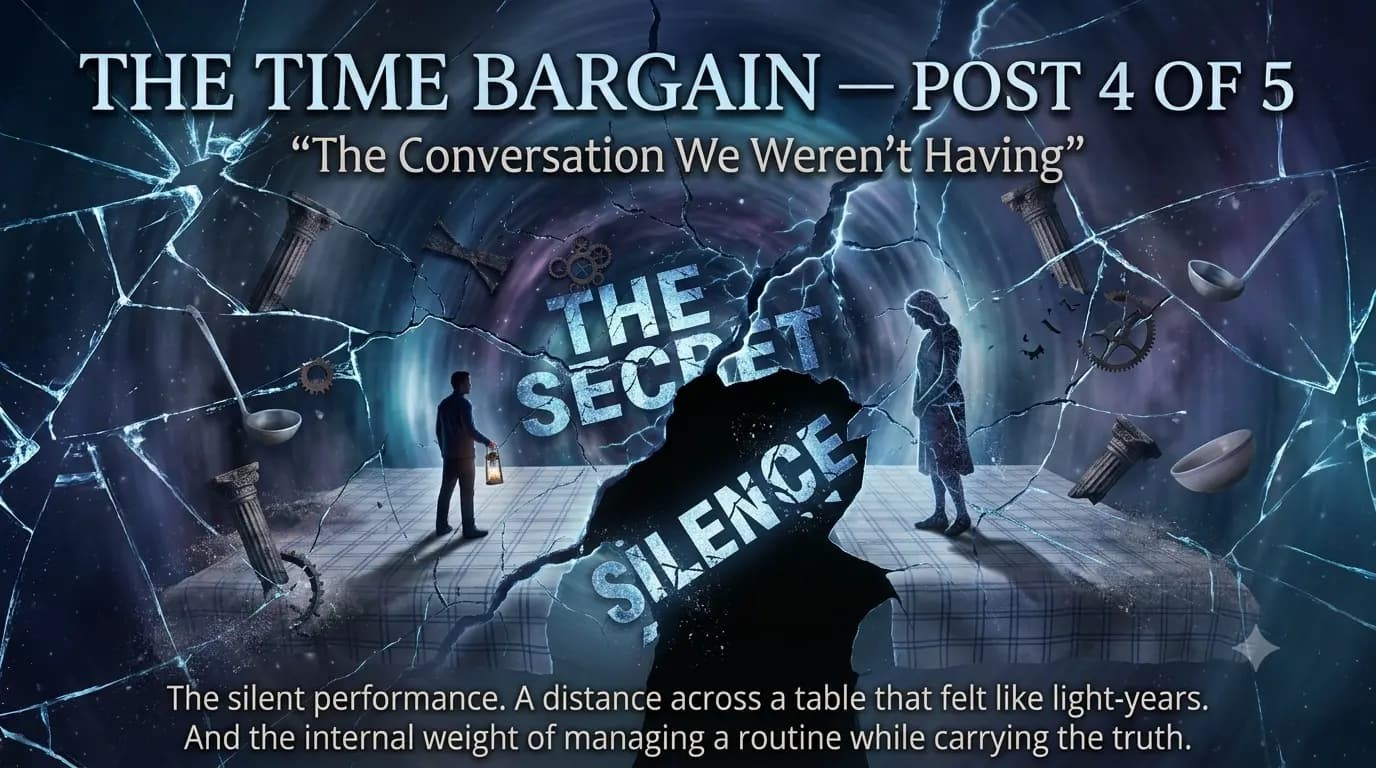
After 42 years, you stop needing words for everything. That’s what made hiding a symptom from your spouse so exhausting — not the secret itself, but the constant, quiet work of managing a rhythm she already knew by heart.
You learn the rhythm of another person so completely that the absence of something says as much as the presence of it. The way they carry themselves into a room. The way they sit down at the table. The way they answer a question just a half beat slower than usual.
Barb and I have been finishing each other’s sentences for decades. Which means keeping a secret from her was never really about what I didn’t say. It was about the enormous amount of energy it took to make sure the rhythm didn’t change.
The Table Between Us
There’s a particular kind of performance that happens at a dinner table when you’re carrying something you haven’t named yet.
You keep the conversation light. You ask about her day. You laugh at the right moments. You do everything a man does when he’s present — except you’re not really present. You’re holding your breath. You’re swallowing around a knot in your throat that has nothing to do with the food, hoping the tightness in your face looks like a smile. Meanwhile the clock on the microwave blinks and the refrigerator hums and the whole house just keeps going like nothing is wrong.
And the soup sitting in front of you is evidence you’re hoping she won’t examine too closely.
It started as a quiet transition — softer foods, easier textures, less resistance going down. I didn’t announce it. I just started reaching for different things. But Barb noticed. Of course she noticed. She’s been feeding this family for 42 years. A shift in what lands on my plate isn’t something that slips past her.
She didn’t say anything direct. She just watched. And waited.
The Art of the Soft Question
That’s the thing about a woman who knows you as well as Barb knows me — she doesn’t come at you head on. She knows better. She knows that pushing too hard closes the door completely so instead she’d ask the kind of questions that left me a way out.
Stanford Medicine’s guidance for spouses of cancer patients names this exact dynamic — the way a deflected fear can quietly teach a partner to stop asking.
She’d ask it without looking up sometimes. Casual. Like it was nothing. But nothing about it was nothing.
You doing okay?
Feeling alright?
That thing getting any worse?
Getting a little sore isn’t it?
Soft. Casual. Almost offhand. But every single one of them was a hand extended in the dark — an invitation to stop performing and just tell her the truth.
And every single time I took the easy exit. I’d answer just enough to satisfy the question without giving her anything real to hold onto. But the moment the words left my mouth, the room felt a little colder. The lie tasted heavier than whatever food I was struggling to chew.
Same story I was telling the guys on the phone. Same story I was telling myself. Tongue bite. Old news. Move on.
What I didn’t fully appreciate at the time was how much energy she was spending on her end of that silence. While I was busy maintaining the performance she was busy deciding how hard to push and how much room to give. That’s its own kind of exhausting — loving someone who isn’t ready to let you in yet.
The Misguided Chivalry
I want to be honest about something because I think a lot of men reading this are going to recognize it.
I told myself the silence was protection.
I wasn’t going to stress her out until I knew for sure what I was dealing with. No point in both of us losing sleep over something that might turn out to be nothing. I was managing the situation. I was being responsible. I was sparing her unnecessary worry.
That’s what I told myself anyway.
What I was actually doing was making a unilateral decision about what she could handle. After 42 years of partnership — after everything we’d walked through together — I decided she needed to be shielded from a lump on my tongue.
That’s not chivalry. That’s just a fancy word for shutting someone out.
The cruelest part is you don’t realize you’re doing it. You genuinely believe you’re being kind. You’re physically in the room, sitting right across the table, but mentally you’re a million miles away guarding something she had every right to know about. And the worst part — you can feel the distance yourself. You just can’t figure out how to close it without blowing the whole thing open.
She felt it. She just loved me enough not to make it a confrontation.
Carrying Her Along
Here’s where it gets complicated.
I was so convinced by my own story — the tongue bite, the Bell’s Palsy history, the bad tooth rubbing wrong — that I think I genuinely brought her along with me. Not intentionally. But when you deliver a denial with enough quiet confidence the people who love you want to believe it. Because the alternative is scarier.
So she half believed it. Or at least she let me believe she did.
When I finally stepped aside and let her make the dentist appointment, we were still operating under the same premise — this was a dental issue. A tooth causing irritation. Something with a simple fix. I hadn’t surrendered to fear. I’d just agreed to get a professional opinion on something we were both pretty sure was nothing.
That’s how thoroughly I’d managed the narrative.
Or so I thought.
What She Actually Knew
Here’s the thing I have to be straight with you about.
I’m currently putting together a questionnaire for Barb and our daughters — trying to get their honest account of what they saw, what they felt, and what they thought during those weeks and beyond. Their perspective on this story. Their version of the silence.
I haven’t gotten those answers back yet.
And I’ll be honest with you — I may be in for a surprise. She may have known a whole lot more than I thought. And looking back, the thought that she might have been sitting across from me, carrying the terrifying truth alone while I played my little game of protection — that is the hardest pill to swallow.
Nobody Fights Alone
I can do all things through Christ who strengthens me.” — Philippians 4:13
Healed and Strong • Scott’s Story • healedandstrong.com