Editor’s Note: This is a companion piece to “Mission Accomplished” — Part 2 of the My Story: Diagnosis Arc series. If you haven’t read it yet, start there. Scott
I’m not a child psychologist. I want to say that up front, because I’m about to tell you what I watched a twelve-year-old do with a cancer diagnosis she never once talked about, and I don’t want you thinking I’ve got a degree behind this. What I’ve got is a year of watching, a lot of getting it wrong in my own head before I got it right, and a granddaughter who taught me more about grief than any adult in my life ever has.
If you’re a parent or grandparent reading this because a kid you love just found out someone in the family is sick, and that kid has gone quiet on you — I think I can help. Not with credentials. With what I actually saw.
She asked about ribbon colors, and never said why.
Emma was in the house Thursday when I told Barb. She was there for the breakdown, there when we FaceTimed Pam, Brandy, and Kristen to give them the diagnosis. She heard all of it.
Friday evening, she asked me, casual as anything, what the ribbon colors were for head, neck, and throat cancer. I didn’t think much of it. Filed it away, said okay, moved on. Had to look them up myself later. Ivory and burgundy.
She never brought it up again. Not a word.
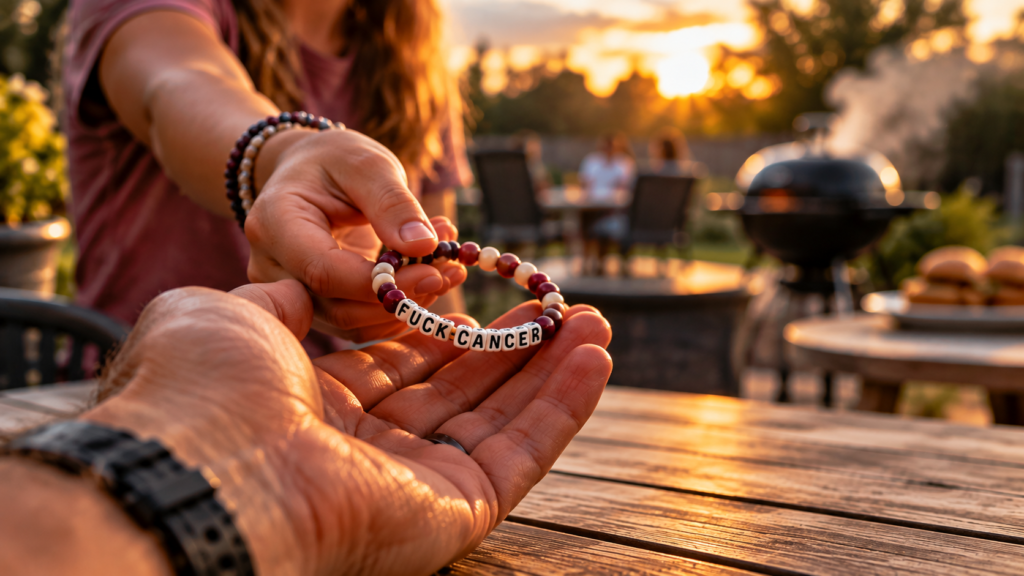
What she did instead — and I didn’t understand this until much later — was track down beads in those exact colors and sit at the porch table the very next day, making something with her hands while the rest of us tried to pretend the sky wasn’t falling. Two days after Barb and I told the girls, she walked over and handed me a bracelet spelling out two words in ivory and burgundy letter blocks. F-U-C-K C-A-N-C-E-R.
That wasn’t silence. That was the loudest thing anybody said to me that whole week. I’ve told that story already — it’s its own piece if you want the whole moment. What I want to talk about here is what came after, because the bracelet wasn’t the end of how Emma processed this. It was the beginning of a pattern that’s held for a full year now.
A year later, we tried again — and the door didn’t just stay closed, it was never open
About a year on, Emma and my daughter Kristen spend a couple weeks together every summer. They’re close — genuinely close — so I asked Kristen if she’d try opening the subject with her. Nothing pushy, knowing Kristen, just soft and gentle, the kind of ask that doesn’t feel like an ambush.
Emma flipped a switch. That’s how Kristen described it, and that’s exactly how Emma operates — she doesn’t mince words, doesn’t skip a beat. The second the conversation turned toward it, Emma turned the subject to the ages of her cats. Not a crack in the door. Not even a door left ajar. Just gone, redirected, closed, like the conversation had never started.
A full year later, that’s still exactly where it sits. No mention, no reference, nothing. As far as I can tell, it’s locked away someplace that’s staying locked for a long, long time.
Here’s what I don’t think that means
My first instinct, if I’m honest, was to worry. I kept waiting for some sign that it was actually bothering her — because when something’s wrong with a kid, you usually see it. Sleep changes. Appetite changes. Grades slipping. In the worse cases, kids get aggressive, or they start pulling away from their friends. That’s real, and if you’re reading this because you’re seeing any of that in your own kid or grandkid, please don’t stop at an article — talk to someone who actually does this for a living. A child psychologist, a school counselor, your pediatrician. I can tell you what I watched. I can’t tell you when it’s gone past normal.
But none of that ever showed up in Emma. Not one sign. And what I’ve come to believe is that her silence wasn’t necessarily telling me something was wrong. It may simply have been the way she needed to cope with something she wasn’t ready — or didn’t need — to put into words.
Here’s how I understand it now. My instinct as an adult was to process everything through conversation. Talk about it. Cry about it. Analyze it six ways from Sunday. Go looking for reassurance. That’s what I was doing with my own daughters. But Emma wasn’t reaching for any of that.
She didn’t run from reality. She just never talked about it. Those are two very different things, and I almost missed the difference.
What I think the cats actually meant
I don’t believe the deflection was denial. I think it was Emma closing a door on her own terms and saying, without saying it: I know what happened. I love you. But I need my world to stay normal right now.
And the bracelet — I think that was the same message, just said the loud way instead of the quiet way. A kid’s version of “I love you, I’m on your side, I’ve got your back.” She said it once, with her hands, at full volume. And then she never had to say it again, because she’d already said everything she needed to.
She still says it now, just not about the cancer directly. If Barb or the girls tease me for being forgetful or doing something goofy, Emma doesn’t hesitate — hand goes up, voice gets stern: “You leave Papa alone.” That’s still her, a year later, still standing guard. She just never needed the word “cancer” to do it.
What I’d tell another parent or grandparent
What worked for me was not pushing. I had to learn that Emma was going to deal with this on her time, not mine. Every instinct in me wanted to make sure she was okay, and talking felt like the obvious way to do that. But every time that door cracked open, she made it pretty clear she wasn’t ready to walk through it.
So I stopped trying to pull her through.
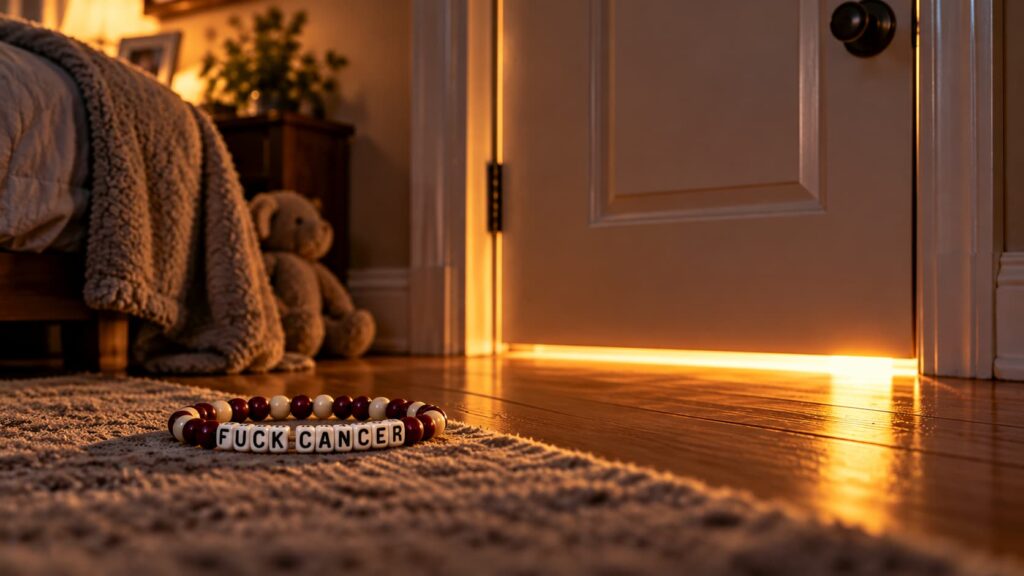
The one thing I would recommend to anybody standing where I was standing is to leave the door open. Let them know, clearly: you never have to talk about this if you don’t want to. But if you ever do — even if it’s just to be mad together, just the two of us — I’m here.
I had to do the harder part: trust that she knew the door was there.
And then, for the love of Jesus, don’t bring it back up. Say it once. Mean it. Let it rest.
Emma taught me that not everything a child needs to say is going to come out in a conversation.
So I started watching the actions. The bracelet. The sudden interest in something specific. The hand going up to defend me when I least expected it. That was Emma’s language. I just had to learn to read it instead of waiting to hear it.
Until next time, stay strong.
“I can do all things through Christ who strengthens me.” — Philippians 4:13