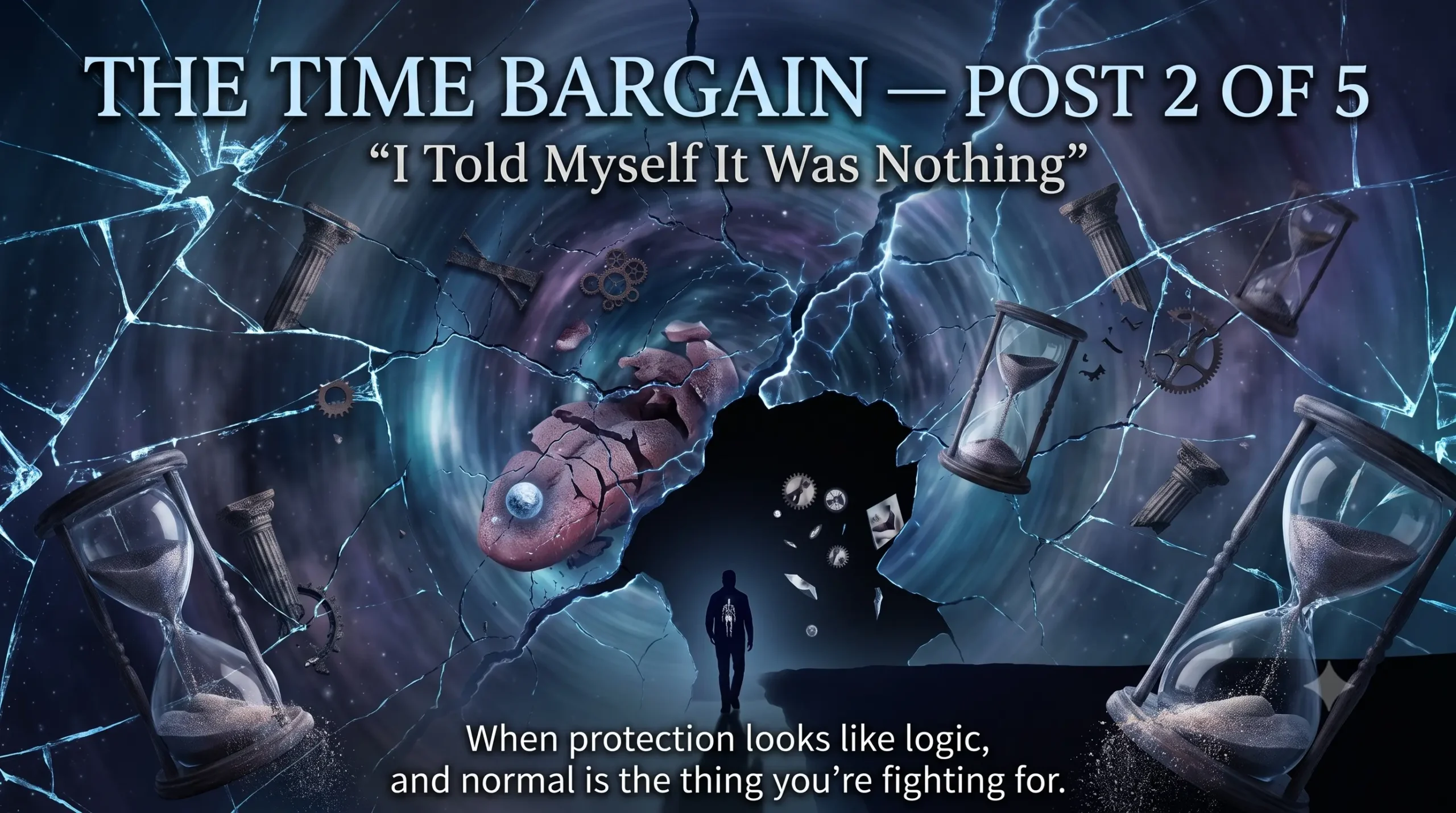
THE TIME BARGAIN — POST 2 OF 6
My finger found it before my brain was ready to deal with it.
A small, hard lump. Left side of my tongue. I was half asleep, probably hadn’t even had coffee yet, and there it was — just sitting there like it owned the place.
My first thought wasn’t panic. It was logistics. I must’ve bitten it in my sleep. My brain went straight to the most boring, most manageable explanation it could find, and it latched on like a bulldog.
And here’s the thing — it wasn’t a random guess. I had history to back it up. Years ago, Bell’s Palsy had me chewing on my own tongue without knowing it. I’d been down that road. I knew what tongue trauma felt like. So I reached back into my personal medical files, pulled out the most comfortable answer I could find, and I went about my day.
That’s the part nobody really talks about. The denial doesn’t feel like denial when you’re in it. It feels like reasoning. It feels responsible, even. You’re not panicking. You’re not overreacting. You’re being sensible.
The Brain’s First Move Is Always Protection: Denial Before Cancer Diagnosis
There’s actually a name for what happens in those first moments. Psychologists call it rationalization — the mind’s way of taking something threatening and dressing it up in familiar clothing so it doesn’t scare you.
But you don’t need a psychology degree to understand it. You just need to remember the last time something felt off and your brain immediately handed you a reason why it probably wasn’t.
It’s just stress.
I slept wrong.
I’ve had this before. It went away last time.
Those aren’t lies, exactly. They’re your brain doing its job — protecting you from a fear you’re not ready to sit with yet. The problem is the brain is real good at that job. Maybe too good.
For me, the Bell’s Palsy explanation wasn’t just convenient. It was credible. I had receipts. And that made it easy to file the whole thing under “been there, done that” and move on.
The Lump Didn’t Care About My Explanation
Here’s what I didn’t account for: the lump wasn’t interested in my reasoning.
It just sat there. Day after day. Quietly minding its business while I went about mine, pretending we hadn’t met.
I’d catch it at odd moments — mid-bite at dinner, lying in bed trying to find a comfortable position, catching my own reflection in the bathroom mirror. And every single time, I’d run the same mental calculation. Still there. But probably nothing. Give it a few more days.
That’s the mechanics of the time bargain, right there. You’re not ignoring the problem. You’re managing it. You’re giving it a deadline. You’re telling yourself you’re in control of the timeline.
What you don’t realize is the timeline’s already moving without you.
What I Was Really Protecting
Looking back, I wasn’t just protecting myself from a scary diagnosis. I was protecting my normal.
And my normal had a rhythm. Work nights. Sleep days. Get up in the evening, do it again. Simple. Predictable. Mine.
The only thing that quietly changed — and I told myself it didn’t mean anything — was dinner. Somewhere in those weeks I stopped reaching for sandwiches and chips and started gravitating toward soup. Easier to get down. Less resistance. I didn’t frame it as accommodating a problem. I just… made a different choice. Kept moving.
That’s what denial looks like from the inside. It doesn’t feel like fear. It feels like adjusting. You don’t stop living your life — you just start making small, silent concessions to something you’re refusing to name. And as long as the routine holds, you can convince yourself nothing’s really wrong.
Because the second you say the words out loud — to your wife, to your doctor, to anybody — the routine is gone. You can’t unsay it. You can’t un-schedule that appointment. The moment you name the thing, it becomes real, and real things have consequences.
So you switch to soup. You keep showing up to work. You keep answering “fine” when somebody asks how you’re doing.
And you keep telling yourself it’s nothing.
Right up until the morning you can’t anymore.
If You’re Sitting in That Space Right Now
If you found this post because something feels off and you’re still in the “it’s probably nothing” phase — I get it. I lived there for weeks.
I’m not going to tell you to panic. But I am going to tell you what I wish somebody had told me:
The thing you’re protecting by waiting isn’t your health. It’s your comfort.
And comfort’s a poor trade for time.
Nobody Fights Alone
I can do all things through Christ who strengthens me.” — Philippians 4:13
Healed and Strong • Scott’s Story • healedandstrong.com